
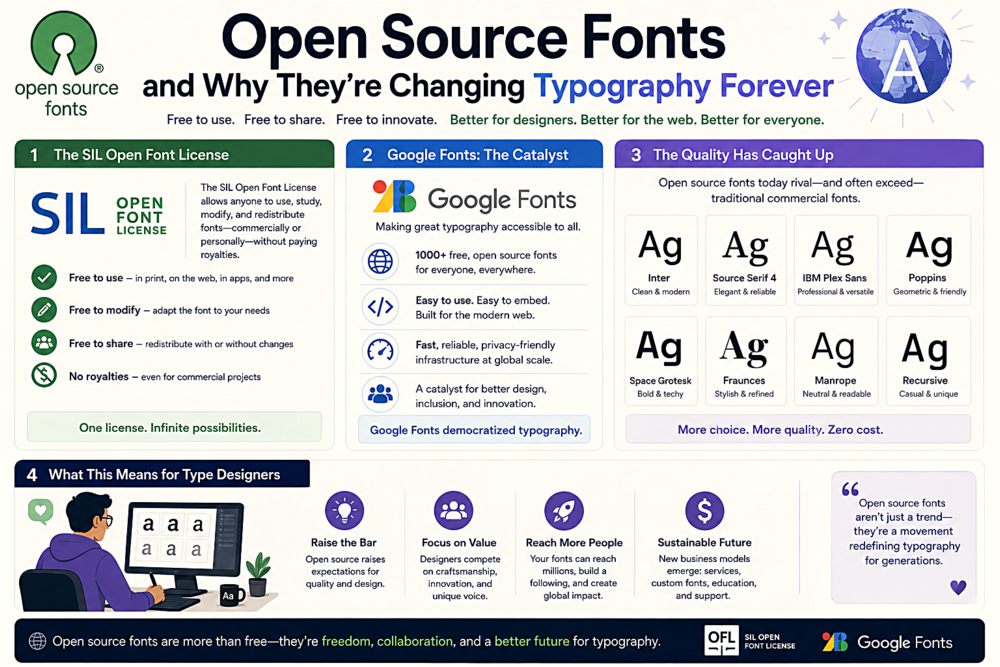
Open Source Fonts and Why They're Changing Typography Forever
In the 1990s, if you wanted to use a font like Garamond, Futura, or Helvetica, you paid for it. Desktop licenses ran from $30 to $500 per font. A full professional type library could cost thousands of dollars. Typography was, in a very real sense, a class marker — only studios and corporations with real budgets could afford the best type.
The SIL Open Font License
The SIL Open Font License, created in 2007 by SIL International (a non-profit linguistics organization), established a legal framework for fonts that are truly free: free to use, free to modify, free to redistribute, and free to embed in commercial products. The only restriction is that derivative works must also be released under the OFL — ensuring the commons keeps growing.
Google Fonts: The Catalyst
Google launched Google Fonts in 2010, commissioning and curating a library of open-source fonts and serving them for free from a global CDN. The impact was immediate and dramatic. Suddenly, every website in the world could use professionally designed typography without any cost or licensing complexity. Millions of designers who had been defaulting to Arial and Times because they couldn't afford alternatives suddenly had hundreds of quality options.
By 2024, Google Fonts serves over 15 trillion font files per month. It's arguably the single most-used design resource in the world.
The Quality Has Caught Up
Early criticism of free fonts was often deserved — many were amateur work with poor spacing, limited character sets, and inconsistent quality. That criticism is increasingly outdated. Today's best open-source fonts — Lora, Merriweather, Source Serif, Inter, Work Sans, Recursive — rival or exceed commercial alternatives in technical quality and design sophistication.
Fonts like Nunito, Raleway, and Playfair Display are used by design professionals worldwide and appear in brand identities for companies that could afford any font they wanted. They chose these because the quality is genuinely excellent.
What This Means for Type Designers
The business model for independent type designers has shifted significantly. Some foundries have found ways to coexist — releasing open-source basic weights while selling extended families, variable fonts, or commercial-specific licenses commercially. Others have moved into custom typography commissioned by large corporations, which pays well precisely because it creates exclusivity in a world where everything else is free.
The Democratization Dividend
The beneficiary of all this is the web. Pages that previously relied entirely on system fonts for legibility now routinely use beautiful, purpose-designed typefaces. International typography — Arabic, Devanagari, CJK scripts — has seen enormous investment from Google and others because open-source funding mechanisms made it possible. Typography that was previously accessible only to literate, wealthy, English-speaking designers is now available to anyone with an internet connection.