
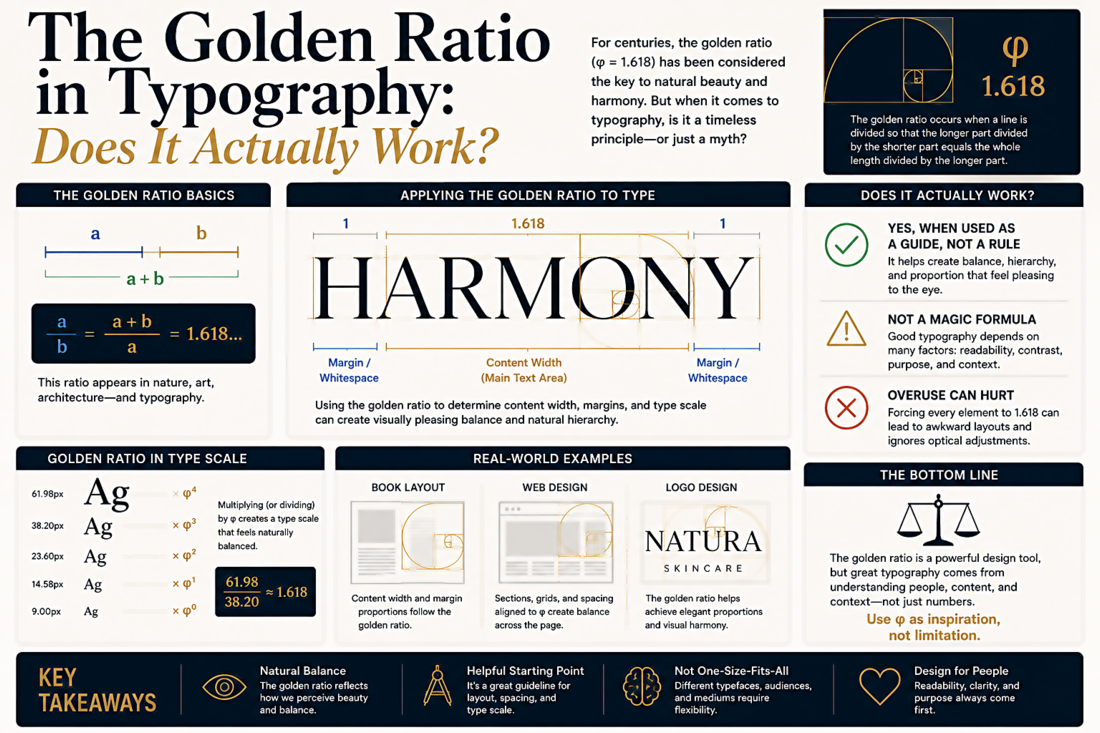
The Golden Ratio in Typography: Does It Actually Work?
The golden ratio (φ = 1.618...) appears throughout nature — in nautilus shells, sunflower spirals, and galaxy arms. Renaissance artists and architects applied it to painting and building proportions. Designers have been trying to apply it to typography ever since. The question worth asking is: does it actually help?
What Is a Modular Type Scale?
A modular type scale is a sequence of font sizes generated by multiplying a base size by a fixed ratio. If your body text is 16px and you use a ratio of 1.25 (the Major Third), your scale would be: 16, 20, 25, 31, 39, 49... Each size is mathematically related to every other.
The golden ratio scale (1.618) from 16px base gives: 16, 26, 42, 67, 109... That jumps dramatically — sizes that work for headings at the larger end are immense.
Common Ratios and Their Personalities
- Minor Second (1.067) — Very subtle differences. Good for dense information design where you need levels but can't afford much space variation.
- Major Second (1.125) — Gentle progression. Works for long-form editorial where headlines aren't meant to dominate.
- Minor Third (1.2) — A good balanced choice for most web design. Creates clear hierarchy without dramatic jumps.
- Major Third (1.25) — Confident step sizes. Popular for marketing sites where visual impact matters.
- Perfect Fourth (1.333) — The point where differences become immediately obvious. Strong hierarchy.
- Golden Ratio (1.618) — Dramatic. Works for large-screen marketing and editorial, difficult for information-dense interfaces.
Does the Math Actually Produce Better Design?
Honestly? The type scale is a starting point, not a solution. Mathematically generated sizes need visual adjustment because optical illusions affect how we perceive size relationships. The Golden Ratio doesn't know that your H2 will appear next to an image, or that your body text will be read on a phone. It produces mathematically consistent sizes — you still have to make them typographically correct.
That said, starting with a rational scale and adjusting is far faster than starting from scratch. Tools like typescale.com and modularscale.com let you preview different ratios instantly.
A Practical Recommendation
Use a Major Third (1.25) or Perfect Fourth (1.333) as your base ratio. Both create clear, practical hierarchy for the range of sizes you'll actually use. Round the generated values to the nearest whole number or round number — 31px becomes 32px, 39px becomes 40px — and you'll have a clean, defensible type scale that's easy to work with in CSS.