
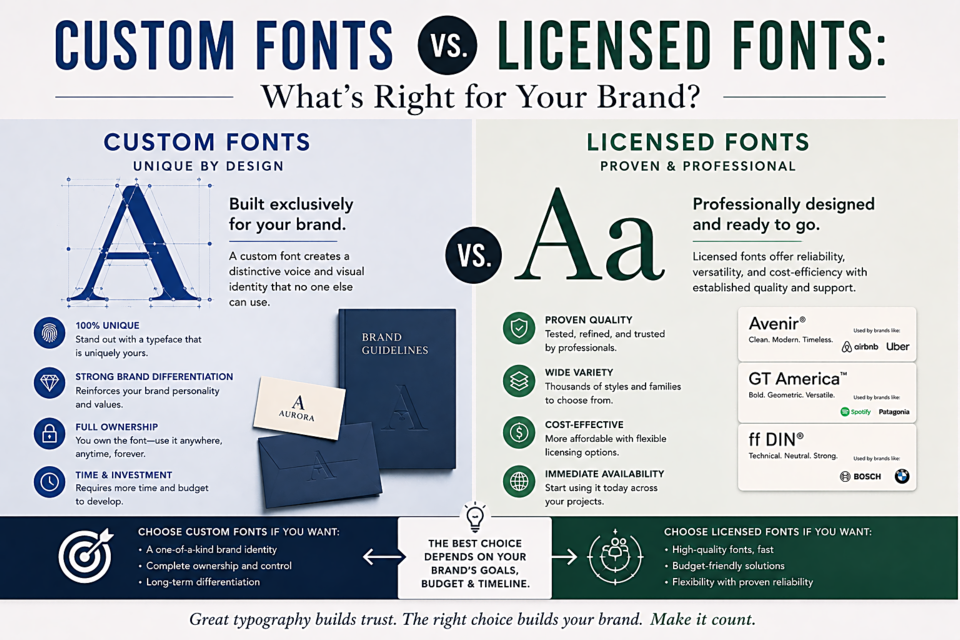
Custom Fonts vs. Licensed Fonts: What's Right for Your Brand?
The Case for Custom Type
A custom typeface is created exclusively for one client. No one else can use it. For brands at a certain scale, this exclusivity has real value — your typographic voice is genuinely proprietary, impossible to replicate without the investment you've made.
Netflix commissioned Netflix Sans from Dalton Maag primarily to eliminate Gotham licensing fees across billions of impressions. Apple has San Francisco, its system font. Airbnb has Cereal. Google has Product Sans. The pattern is clear: once a brand reaches the scale where font licensing fees become significant, and once consistent brand expression across all touchpoints becomes mission-critical, custom typography is often cheaper in the long run.
What Custom Type Costs
Custom typeface development from a top foundry (Dalton Maag, Commercial Type, Hoefler&Co) typically runs from $50,000 to $500,000+ depending on the complexity and number of styles. A text family with multiple weights and a complementary display family would be on the higher end. A single-weight display font could be on the lower end.
For most businesses, this is clearly not the right investment. But for businesses spending more than $10,000–20,000 per year on font licensing, or for brands where typographic distinctiveness is a strategic competitive advantage, the math can work.
The Middle Path: Exclusive Licensing
Some type foundries offer exclusive or semi-exclusive licenses — you pay a premium and the foundry agrees not to license the font to your direct competitors for a defined period. This provides brand differentiation without the cost of full custom development.
When Licensed Fonts Are Absolutely Fine
For the vast majority of organizations — even quite large ones — a carefully chosen licensed font is the right choice. The differentiation comes from how you use typography (scale, color, hierarchy, combination) rather than from font exclusivity. Apple used Myriad Pro — an Adobe font used by thousands of other companies — and still built one of the most distinctive brand identities in history. The execution mattered more than the exclusivity.
Questions to Ask Before Commissioning Custom Type
- Does our current font limit what we want to say?
- Are competitors using the same font in ways that diminish our distinctiveness?
- Is typography a primary vehicle for our brand expression, or a supporting element?
- Can we afford the time investment? (Custom type typically takes 12–24 months)
- Do we have the internal brand management capacity to maintain and enforce custom type usage?